The Temple Mount Explained
The Temple Mount is the holiest site in Judaism and one of the most contested places on earth — home to the First and Second Temples, the Dome of the Rock, and centuries of conflict and devotion.
The Center of Everything
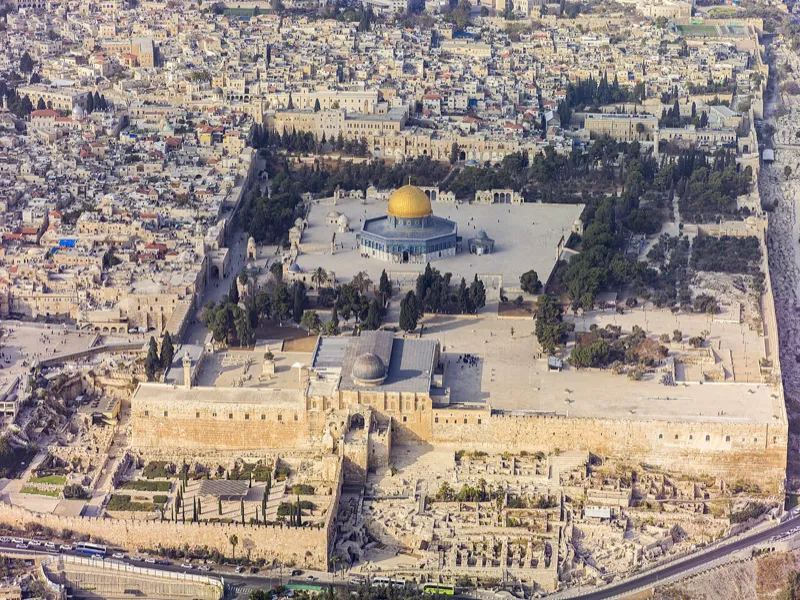
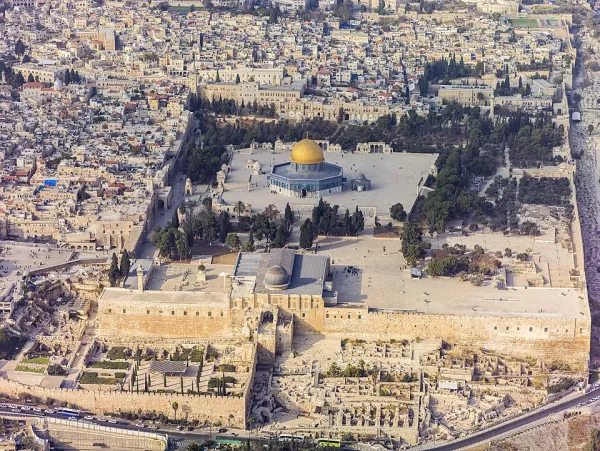
There is a spot in Jerusalem where three faiths converge, where ancient history presses against modern politics, and where every stone carries the weight of millennia. The Temple Mount — Har HaBayit in Hebrew, Haram al-Sharif (the Noble Sanctuary) in Arabic — is a roughly 37-acre elevated platform in the Old City of Jerusalem that is, depending on whom you ask, the holiest site in Judaism, the third holiest in Islam, and one of the most politically explosive pieces of real estate on earth.
To understand the Temple Mount is to understand much of the history — and the heartbreak — of the Jewish people.
The Foundation Stone
Jewish tradition holds that the Temple Mount contains the Even HaShetiyah — the Foundation Stone, the very spot from which God created the world. According to the Midrash, this is where Adam was formed from dust, where Abraham bound Isaac for sacrifice (Akeidat Yitzchak), and where Jacob dreamed of a ladder reaching to heaven.
Whether one takes these traditions literally or symbolically, the theological point is clear: the Temple Mount is, for Judaism, the axis mundi — the point where heaven and earth connect.
The First Temple
Around 957 BCE, King Solomon built the First Temple (Beit HaMikdash) on the mount. The Bible devotes extensive chapters (1 Kings 5-8) to its construction: cedar from Lebanon, gold overlays, carved cherubim, and at its heart, the Holy of Holies (Kodesh HaKodashim), a windowless chamber housing the Ark of the Covenant containing the tablets of the Ten Commandments.
The First Temple was the center of Israelite worship for nearly four centuries. Three times a year — on Passover, Shavuot, and Sukkot — Jews made pilgrimage to the Temple. Priests offered daily sacrifices. The High Priest entered the Holy of Holies once a year, on Yom Kippur, to atone for the sins of the nation.
In 586 BCE, the Babylonian king Nebuchadnezzar II besieged Jerusalem, destroyed the Temple, and exiled much of the population to Babylon. The Ark of the Covenant vanished — its fate remains one of history’s great mysteries.
The Second Temple
When the Persian king Cyrus conquered Babylon in 539 BCE, he permitted the Jews to return to Jerusalem and rebuild. The Second Temple was completed around 516 BCE, though it was far more modest than Solomon’s original.
The Second Temple stood for nearly 600 years. It was the center of Jewish life during the Persian, Hellenistic, and Roman periods. Around 20 BCE, King Herod the Great undertook a massive expansion, transforming the Temple Mount into one of the ancient world’s most impressive architectural complexes. He doubled the size of the platform, built enormous retaining walls (the Western Wall is part of this construction), and adorned the Temple with gold and white stone so brilliant that, according to the historian Josephus, looking directly at it in sunlight could blind you.
The Second Temple period was a time of enormous religious creativity. The Pharisees, Sadducees, Essenes, and early Christians all operated during this era. The synagogue developed as an institution, partly in response to the impossibility of constant pilgrimage. Much of what would become rabbinic Judaism was taking shape.
In 70 CE, the Roman general Titus besieged Jerusalem during the Great Jewish Revolt. After months of brutal fighting, the Romans breached the walls, stormed the Temple Mount, and burned the Temple on the 9th of Av (Tisha B’Av) — the same date, tradition holds, on which the First Temple had been destroyed nearly seven centuries earlier. The destruction was catastrophic. Judaism lost its central sanctuary, its priesthood, and its sacrificial system. Everything had to be reinvented.
After the Destruction
The loss of the Temple transformed Judaism. The rabbis, led by Yochanan ben Zakkai, rebuilt Jewish life around prayer, study, and the synagogue — replacing sacrifices with words, the Temple with the study hall, the priest with the rabbi. The Talmud is, in many ways, a literature of rebuilding after catastrophe.
But the Temple Mount was never forgotten. Jews continued to pray facing Jerusalem. The liturgy is saturated with references to the Temple and prayers for its rebuilding. On Tisha B’Av, Jews fast and mourn as if the destruction happened yesterday. The phrase “Next year in Jerusalem” — recited at every Passover seder and Yom Kippur — expresses a longing that has persisted for two thousand years.
The Islamic Period
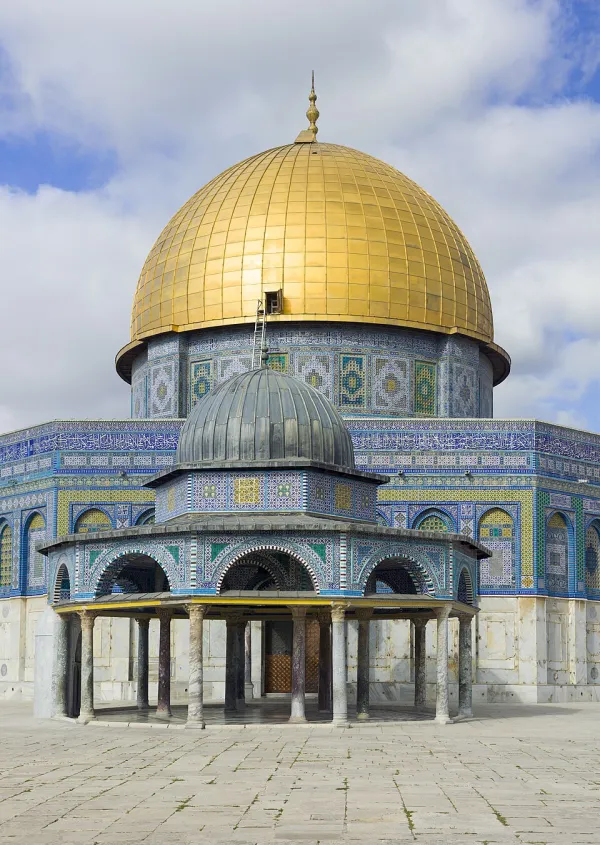
After the Muslim conquest of Jerusalem in 638 CE, Caliph Umar ibn al-Khattab cleared the Temple Mount, which had been used as a dump under Byzantine rule. His successor, Caliph Abd al-Malik, built the Dome of the Rock (Qubbat al-Sakhra) in 691 CE — the golden-domed structure that dominates Jerusalem’s skyline. The Al-Aqsa Mosque was built at the southern end of the platform around the same time.
For Muslims, the site is where the Prophet Muhammad ascended to heaven during the Night Journey (Isra and Mi’raj). The Dome of the Rock sits atop the same Foundation Stone that Jews revere — a perfect symbol of how sacred geography can be shared and contested simultaneously.
The Status Quo
When Israel captured the Old City of Jerusalem in the Six-Day War of 1967, Defense Minister Moshe Dayan made a fateful decision: he handed day-to-day administration of the Temple Mount back to the Waqf, the Islamic trust that had managed it under Jordanian rule. Israel maintained overall security control, but the Waqf would manage religious affairs on the mount.
This arrangement, known as the status quo, means:
- Muslims may pray on the Temple Mount freely
- Jews may visit during designated hours but may not pray on the mount
- Israeli police enforce the arrangement and may restrict access during periods of tension
The status quo is opposed by different groups for different reasons. Jewish Temple Mount activists want the right to pray at Judaism’s holiest site. Palestinian leaders fear any change to the status quo as a prelude to Israeli takeover. Successive Israeli governments have maintained the arrangement to avoid a wider conflagration.
The Rabbinical Debate
Many Orthodox rabbis actually prohibit Jews from ascending the Temple Mount at all. The reasoning: the exact boundaries of the Temple’s sacred zones — particularly the Holy of Holies — are unknown. Since ritual impurity (tum’ah) cannot be fully removed today (it required ashes of the Red Heifer), entering the Holy of Holies area in a state of impurity would be a grave sin.
Other rabbis permit entry to certain areas of the mount that are clearly outside the Temple’s sacred precincts. The debate is intense and ongoing, with both sides marshaling detailed halakhic arguments.
A Living Conflict
The Temple Mount remains one of the most sensitive flashpoints in the Israeli-Palestinian conflict. Ariel Sharon’s visit to the mount in September 2000 was cited as a trigger for the Second Intifada. Restrictions on access periodically spark protests and violence. UNESCO resolutions about the site’s status provoke fury from Israeli officials.
Yet for millions of Jews, the Temple Mount remains what it has always been: the place where God’s presence was once most concentrated on earth, the site of unimaginable destruction, and the focus of an undying hope. Whether one prays for the literal rebuilding of the Temple or understands that hope metaphorically, the Temple Mount endures as the spiritual center of the Jewish world.
Frequently Asked Questions
Why can't Jews pray on the Temple Mount?
Under the current 'status quo' arrangement dating to 1967, Jews are permitted to visit the Temple Mount but not to pray there. This arrangement is maintained by Israel to avoid inflaming tensions with the Muslim world, as the Al-Aqsa Mosque and Dome of the Rock sit on the mount. Also, many Orthodox rabbis prohibit Jewish entry to the Temple Mount because the exact location of the Holy of Holies is unknown, and an impure person entering that area would violate a severe biblical prohibition.
What happened to the Jewish Temples?
The First Temple, built by King Solomon around 957 BCE, was destroyed by the Babylonians under Nebuchadnezzar in 586 BCE. The Second Temple, rebuilt around 516 BCE and greatly expanded by King Herod, was destroyed by the Romans in 70 CE. Both destructions are commemorated on Tisha B'Av, the saddest day in the Jewish calendar.
Is the Temple Mount the same as the Western Wall?
No. The Temple Mount (Har HaBayit) is the elevated platform where the Temples stood. The Western Wall (Kotel) is a retaining wall on the western side of the Temple Mount complex, built by King Herod as part of his expansion of the Second Temple platform. The Western Wall is the closest accessible point to where the Holy of Holies once stood, which is why it became the holiest place where Jews pray.
Sources & Further Reading
Related Articles
Ancient Israel: From Abraham to the Kingdoms
The foundational story of the Jewish people — from the call of Abraham through the united monarchy of David and Solomon.
Jerusalem: 3,000 Years of Faith, Conflict, and Hope
For three millennia, Jerusalem has been the spiritual heart of the Jewish people — and a city sacred to three faiths. Its story is one of devotion, destruction, and enduring hope.
The Western Wall (Kotel): Judaism's Holiest Place of Prayer
The Western Wall — the last remnant of the ancient Temple Mount — is where Jews have prayed, wept, and celebrated for centuries. It is a place of profound spiritual power.