Noam Chomsky: Revolutionary Linguist and Political Dissident
Noam Chomsky transformed our understanding of language and became the world's most prominent political dissident — both roles rooted in the Jewish intellectual tradition of questioning authority.
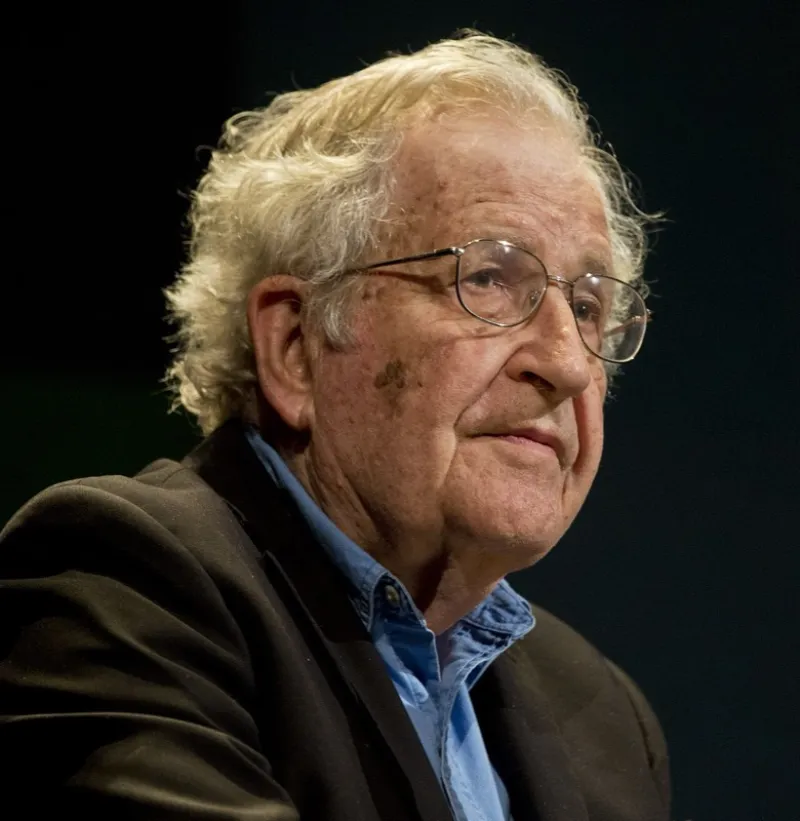
The Father of Modern Linguistics
Avram Noam Chomsky was born on December 7, 1928, in Philadelphia, Pennsylvania. His father, William (Ze’ev) Chomsky, had fled Ukraine in 1913 to avoid conscription into the Czar’s army. William became one of the foremost Hebrew scholars in America, teaching at Gratz College and publishing a definitive grammar of medieval Hebrew. His mother, Elsie Simonofsky, was a teacher and activist.
Young Noam grew up in a household saturated with Jewish learning. He attended a Hebrew-medium elementary school (Mikveh Israel), where instruction was conducted almost entirely in Hebrew. The family discussed politics, linguistics, and Jewish culture around the dinner table. By his own account, Chomsky was reading widely by age ten and frequenting the anarchist bookstores of New York’s Lower East Side by his early teens.
The Linguistic Revolution
In 1955, Chomsky completed his PhD at the University of Pennsylvania and joined MIT, where he would spend his entire career. His doctoral thesis, and the 1957 book Syntactic Structures that grew from it, launched a revolution in linguistics.
The prevailing view, championed by B.F. Skinner and the behaviorists, held that language was learned entirely through imitation and reinforcement — children hear language, repeat it, and are corrected until they get it right. Chomsky demolished this view. He argued that children learn language too quickly and too creatively to be merely imitating adults. A child can produce sentences she has never heard before. She knows intuitively that “the dog bit the man” and “the man was bitten by the dog” mean the same thing, even though no one taught her this.
Chomsky proposed that humans are born with an innate capacity for language — a universal grammar that underlies all human languages. The specific language a child learns depends on her environment, but the deep structure is hardwired. This was a profoundly Jewish insight in a way: the idea that beneath the surface diversity of the world’s languages lies a common structure is reminiscent of the kabbalistic notion of hidden unity beneath apparent multiplicity.
Political Activism
In 1967, Chomsky published “The Responsibility of Intellectuals” in The New York Review of Books, arguing that intellectuals have a moral obligation to speak truth to power. The essay, written in response to the Vietnam War, launched his second career as America’s most prominent political dissident.
Over the following decades, Chomsky produced a staggering volume of political writing — over 100 books and thousands of articles — criticizing U.S. foreign policy, corporate power, media manipulation, and economic inequality. His 1988 book Manufacturing Consent (co-authored with Edward Herman) argued that the mainstream media serves the interests of the powerful by filtering news through institutional biases.
His political views — anarcho-syndicalist, anti-imperialist, deeply skeptical of state power — were rooted in the same Jewish intellectual tradition that produced his linguistics. The prophetic tradition of speaking truth to power, the rabbinic tradition of questioning authority, the Jewish commitment to social justice — all of these ran through Chomsky’s political work.
Jewish Identity and Israel
Chomsky’s relationship with Israel and Zionism is complex and controversial. As a young man, he spent time on a kibbutz and was attracted to Labor Zionism’s socialist ideals. But he became increasingly critical of Israeli policy toward Palestinians, particularly after the 1967 war. He has advocated for a binational state and has been a vocal critic of the occupation.
This has made him a deeply polarizing figure in the Jewish community. His supporters see him as embodying the prophetic tradition of self-criticism — the idea that loving your people means holding them to the highest moral standards. His critics accuse him of providing intellectual cover for antisemitism.
What is beyond dispute is that Chomsky’s Jewishness — his immersion in Hebrew, his grounding in Jewish intellectual culture, his father’s scholarship — shaped everything he became. The Jewish tradition of argument, of never accepting easy answers, of insisting that intellectuals have moral obligations — these are the foundations of both his linguistics and his politics.
Noam Chomsky remains, in his nineties, one of the most cited scholars in history and one of the most controversial public intellectuals alive — a Jewish thinker in the fullest sense, whose life’s work has been to ask the questions that no one else will ask.
Frequently Asked Questions
What is Noam Chomsky's theory of universal grammar?
Chomsky proposed that the ability to learn language is innate to humans — that we are born with a 'language acquisition device' containing a universal grammar common to all languages. This was revolutionary because it challenged the prevailing behaviorist view that language is purely learned through imitation and reinforcement.
Is Noam Chomsky Jewish?
Yes. Chomsky was born to Jewish parents in Philadelphia. His father, William Chomsky, was a renowned Hebrew scholar who fled Ukraine in 1913. Young Noam grew up immersed in Hebrew language and Jewish intellectual culture, attending a Hebrew-medium elementary school and spending time on a kibbutz as a young man.
What are Chomsky's political views?
Chomsky describes himself as a libertarian socialist and anarcho-syndicalist. He has been one of the most prominent critics of U.S. foreign policy, corporate media, and capitalism. His political writings — including Manufacturing Consent and Hegemony or Survival — have influenced generations of activists and scholars worldwide.
Key Terms
Sources & Further Reading
Related Articles
Albert Einstein: Genius, Refugee, and Jewish Icon
He revolutionized physics, fled Nazi Germany, was offered the presidency of Israel (and declined), played the violin, and became the most recognized scientist in history. Einstein's Jewish identity shaped his life in ways most people never learn about.
Hebrew: The Language of the Torah and Israel
From an ancient sacred tongue to a modern spoken language — the remarkable story of Hebrew's revival.
Jewish Ethics: A Guide to Moral Living
From Hillel's golden rule to the Mussar movement, Jewish ethics offers a comprehensive framework for moral living — covering speech, the environment, labor rights, medical decisions, and the obligation to repair the world.