The Inquisition and the Jews: Conversos, Crypto-Jews, and Survival
The story of the Spanish and Portuguese Inquisitions — forced conversion, crypto-Judaism, auto-da-fé, and the remarkable survival of secret Jewish communities across five centuries.
The Fires of Faith
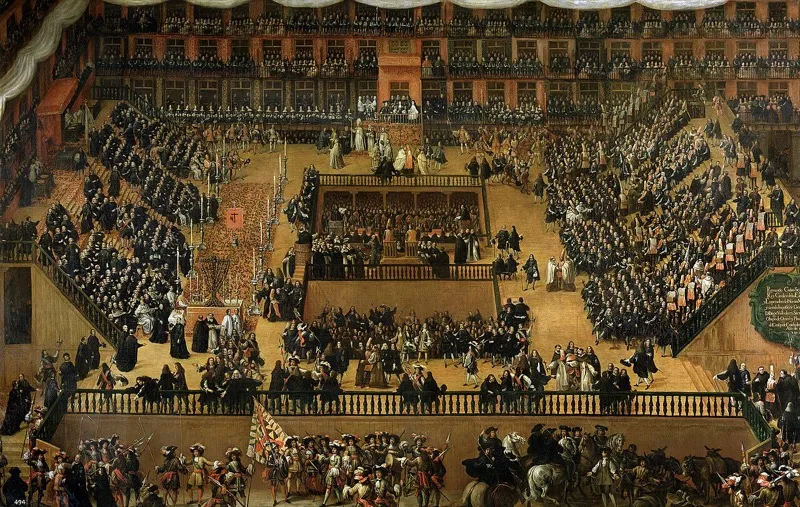
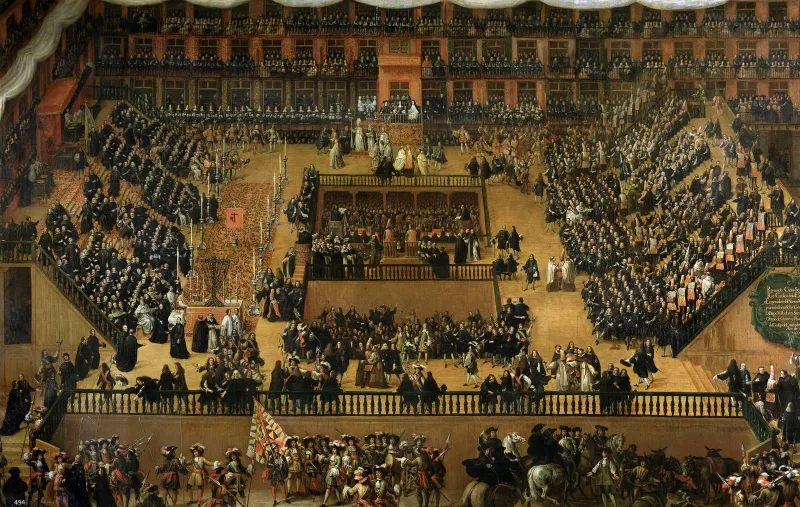
In the great plazas of Spanish and Portuguese cities — Seville, Toledo, Lisbon, Madrid — crowds gathered for a spectacle. On a raised platform, prisoners wearing pointed hats and yellow robes painted with flames stood before inquisitors. Their crimes were read aloud: lighting candles on Friday nights, refusing to eat pork, changing bed linens before Saturday, washing the dead in a certain way. The punishments ranged from public humiliation to imprisonment to confiscation of property. And for the condemned — those who refused to recant or who had relapsed into heresy — there was the stake.
These ceremonies were called auto-da-fé — “acts of faith.” They were the public face of the Inquisition, and they cast a shadow over Jewish and converso life in the Iberian Peninsula for more than three centuries.
The story of the Inquisition is a story about power, identity, survival, and the lengths to which people will go to preserve what they believe. It is also a story that is not over — because the descendants of those who were forced to convert are still discovering who they are.
Before the Inquisition: Conversion Under Duress
The Inquisition did not appear in a vacuum. It was the culmination of a century of escalating anti-Jewish violence in Spain. During the Golden Age, Jews had flourished under Muslim and early Christian rule. But as the Christian Reconquista pushed southward and Catholic religious fervor intensified, Jewish communities came under increasing pressure.
The crisis began in 1391, when anti-Jewish riots swept across Spain. In city after city — Seville, Córdoba, Valencia, Barcelona — mobs attacked Jewish quarters, killing thousands and offering the survivors a stark choice: baptism or death. Tens of thousands of Jews converted to Christianity under this pressure. They became known as conversos — converts.
The conversions created an unprecedented situation. Suddenly, a large population of former Jews — many of whom had converted insincerely, under threat of murder — existed within Christian society. As Christians, they could now enter professions, own property, and hold offices previously closed to Jews. Many converso families rose to positions of power and wealth within a generation. Some became bishops, royal advisors, and prominent merchants.
This success bred resentment. “Old Christians” — those who claimed no Jewish ancestry — looked at converso achievements with suspicion and jealousy. Were these converts really Christian? Or were they secretly still Jews, contaminating the Church from within?
The Inquisition Arrives
In 1478, King Ferdinand and Queen Isabella petitioned Pope Sixtus IV to establish an Inquisition in Spain. Its stated purpose was not to target Jews (who were still permitted to practice their religion) but to investigate conversos suspected of Judaizing — secretly practicing Jewish rituals.
The Inquisition was unlike any institution that had existed before. It combined the authority of the Church with the power of the state. Its proceedings were secret. Accused persons were not told who had denounced them. Testimony extracted under torture was admissible. Property confiscated from the condemned enriched both the Crown and the Church.
The first Grand Inquisitor, Tomás de Torquemada — himself of converso descent, ironically — established the Inquisition’s procedures and oversaw its most intense period. Between 1480 and 1530, the Spanish Inquisition tried tens of thousands of cases and burned approximately two thousand people at the stake.
What the Inquisition Looked For
Inquisitors compiled detailed lists of “Judaizing” behaviors:
- Lighting candles on Friday evening
- Changing bed linens and wearing clean clothes on Saturday
- Fasting on Yom Kippur (the “Great Day”)
- Eating unleavened bread during Passover
- Avoiding pork, shellfish, or mixing meat and milk
- Washing and preparing the dead in specific ways
- Turning to face a wall when dying
- Giving children Hebrew names
- Reciting certain prayers
The cruelty of this system is difficult to overstate. Everyday domestic activities — changing sheets, lighting candles, cooking certain foods — became evidence of criminal heresy. Servants, neighbors, even family members were encouraged to inform on suspected Judaizers. The atmosphere of surveillance and suspicion corroded trust and made genuine religious practice of any kind dangerous.
The Expulsion of 1492
The existence of practicing Jews in Spain was considered a source of temptation for conversos. In March 1492 — the same month Columbus set sail — Ferdinand and Isabella signed the Alhambra Decree, ordering all Jews to convert or leave Spain within four months.
An estimated 100,000-200,000 Jews chose exile over conversion. They scattered across the Mediterranean — to the Ottoman Empire (which welcomed them), North Africa, Italy, and the Netherlands. They carried with them the Ladino language, the Sephardic liturgical tradition, and the memory of what they had lost. These communities became the foundation of the global Sephardic diaspora.
Those who stayed and converted joined the converso population — now even more suspect in the eyes of the Inquisition, since their conversion was obviously coerced.
The Portuguese Inquisition
Portugal initially welcomed Spanish Jewish refugees, but in 1497, King Manuel I ordered all Jews in Portugal to convert — not as individuals but en masse. Jews were dragged to baptismal fonts. Children were torn from their parents and baptized. The entire Jewish community of Portugal became Christian overnight.
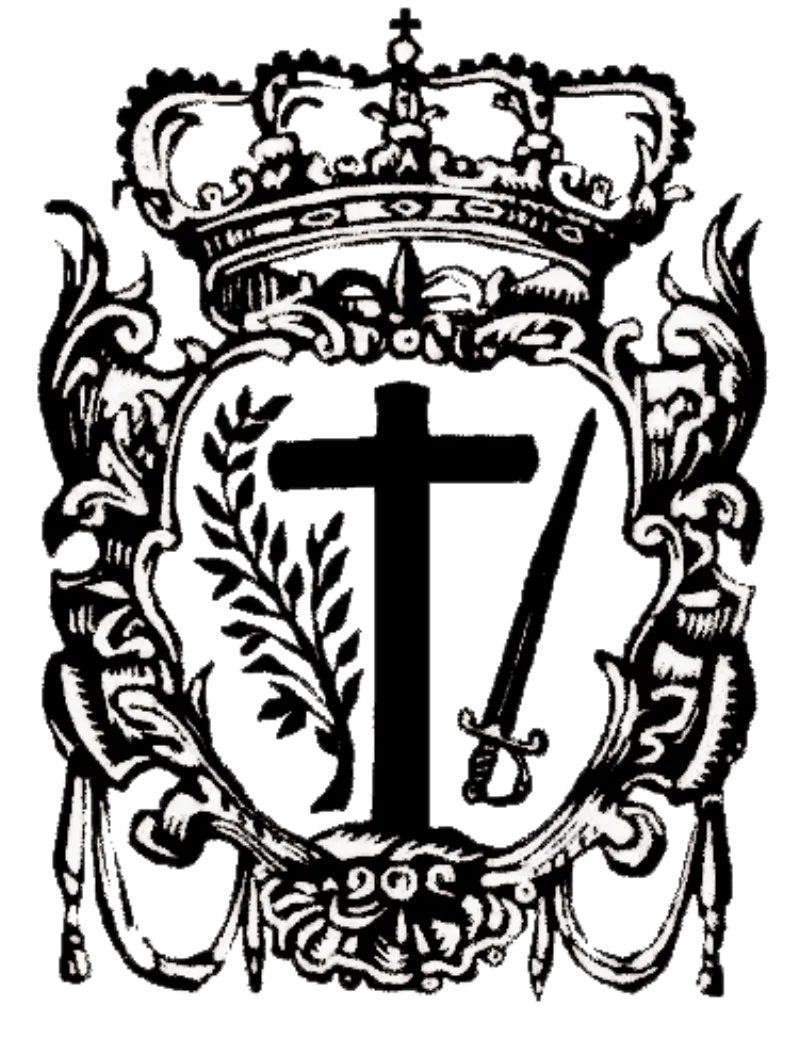
The Portuguese Inquisition, established in 1536, was in some ways even more devastating than its Spanish counterpart. Because the entire Jewish population had been forcibly converted, every person of Jewish ancestry was potentially suspect. The Inquisition operated in Portugal for nearly 300 years, with its last auto-da-fé taking place in 1765.
The Crypto-Jews: Judaism in Secret
Despite the Inquisition’s relentless surveillance, many converso families maintained Jewish practices in secret — sometimes for generations, sometimes for centuries. These crypto-Jews (or anusim — “forced ones” in Hebrew) developed ingenious strategies for preserving their identity:
- They lit Shabbat candles inside closets or in basements
- They fasted secretly on Yom Kippur while pretending to eat normally
- They kept kosher as much as possible while maintaining a public appearance of eating Christian foods
- They married within converso networks to preserve their secret
- They transmitted prayers — often garbled over generations — from mother to daughter
- They celebrated a version of Passover, sometimes calling Queen Esther their patron saint to disguise Purim observance as Catholic devotion
Over time, much of the original Jewish knowledge was lost. Prayers were corrupted. Practices became detached from their sources. What remained were fragments — customs whose origins were forgotten but whose persistence was remarkable.
The New World
Conversos sailed with Columbus in 1492 and were among the earliest European settlers in the Americas. They settled in Mexico, Brazil, Peru, Colombia, and throughout the Caribbean — sometimes seeking distance from the Inquisition, sometimes finding that the Inquisition followed them.
The Inquisition operated in Mexico from 1571 to 1820 and in Lima, Peru from 1570 to 1820. Notable cases included the Carvajal family in Mexico, several members of which were burned at the stake for Judaizing in the 1590s.
In New Mexico, converso families maintained crypto-Jewish practices that persisted into the 20th century. Scholars have documented families in remote villages who avoided pork, lit Friday night candles, and observed other Jewish customs — often without understanding their origin.
The Bnei Anusim Today
One of the most remarkable chapters of the Inquisition’s story is still being written. Across the Spanish and Portuguese-speaking world, people are discovering Jewish ancestry traced to converso families. They are called Bnei Anusim — “descendants of the forced ones.”
In places as diverse as northern Portugal, southern Spain, the Brazilian Amazon, Colombia, and the American Southwest, individuals and communities are:
- Researching family histories and finding Inquisition records documenting their ancestors’ trials
- Recognizing family customs — avoiding pork, lighting Friday candles, covering mirrors during mourning — as vestigial Jewish practices
- Formally converting (or, as many prefer to say, “returning”) to Judaism
- DNA studies revealing Sephardic Jewish ancestry in populations across Latin America
In 2015, both Spain and Portugal passed laws offering citizenship to descendants of Jews expelled during the Inquisition — a symbolic acknowledgment, over five centuries late, of the injustice done.
The Inquisition sought to destroy Judaism in the Iberian Peninsula. It failed. Not completely, not neatly, not without terrible cost — but it failed. The practices survived in closets and basements. The identity survived in family stories and unexplained customs. And now, five hundred years later, the descendants are coming home.
“They tried to bury us. They did not know we were seeds.” — Proverb adopted by Bnei Anusim communities
Frequently Asked Questions
What was the Spanish Inquisition?
The Spanish Inquisition was a tribunal established in 1478 by King Ferdinand and Queen Isabella to identify and punish heresy — specifically, to investigate whether Jews and Muslims who had converted to Christianity (conversos and moriscos) were secretly practicing their original religions. It operated for over 350 years, using informers, torture, and public burnings (auto-da-fé) to enforce religious conformity.
What are conversos and marranos?
Conversos ('converts') were Jews who converted to Christianity, either voluntarily or under duress. 'Marranos' (likely from the Spanish for 'swine') was a derogatory term applied to conversos suspected of secretly practicing Judaism. Many scholars prefer 'crypto-Jews' or 'anusim' (Hebrew for 'forced ones'). The converso experience was extraordinarily complex — some became sincere Christians, some maintained secret Jewish practices, and many existed in an agonizing middle ground.
Who are the Bnei Anusim?
Bnei Anusim ('descendants of the forced ones') are people around the world — particularly in Spain, Portugal, Latin America, and the American Southwest — who have discovered Jewish ancestry traced to converso families. Some preserve customs (lighting Friday night candles, avoiding pork, sweeping toward the center of a room) without knowing their origin. Growing numbers are formally returning to Judaism, creating a remarkable chapter of reconnection after five centuries.
Sources & Further Reading
- Jewish Virtual Library — The Inquisition ↗
- My Jewish Learning — Conversos ↗
- Henry Charles Lea, A History of the Inquisition of Spain
- David Gitlitz, Secrecy and Deceit: The Religion of the Crypto-Jews
Related Articles
Understanding Antisemitism: History, Forms, and the Fight Against Hatred
Antisemitism — hatred of Jews — is one of the oldest and most persistent forms of prejudice. From ancient expulsions to modern online hate, understanding its roots is the first step toward fighting it.
The Golden Age of Jewish Spain
For centuries, Jews in Muslim and Christian Spain created an extraordinary civilization of poetry, philosophy, science, and interfaith dialogue.
Sephardi vs Ashkenazi: Two Streams of Jewish Life
Sephardi and Ashkenazi Jews share the same Torah but developed distinct languages, liturgies, foods, and customs across centuries of separation — two rivers from one source.