Carl Sagan: The Astronomer Who Made the Universe Personal
Carl Sagan made the universe accessible to millions through Cosmos, the 'pale blue dot' speech, and a gift for wonder that reflected his Jewish intellectual heritage.
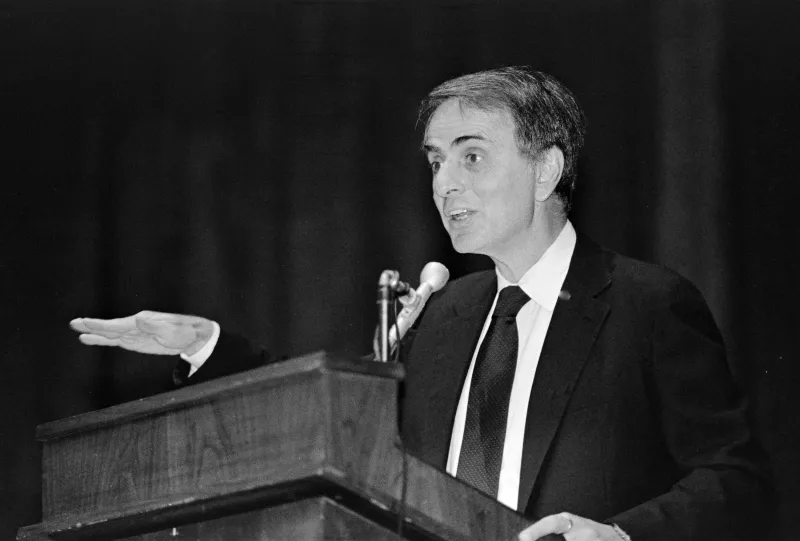
“We Are Made of Star-Stuff”
Carl Edward Sagan was born on November 9, 1934, in Brooklyn, New York. His father, Samuel Sagan, was a garment worker who had emigrated from Kamianets-Podilskyi in what is now Ukraine. His mother, Rachel Molly Gruber, was a housewife from a New York Jewish family. They were not wealthy, but they gave their son something more valuable than money: a sense of wonder.
Young Carl’s defining moment came at the 1939 World’s Fair in New York. He was five years old. He saw a time capsule buried for future generations, exhibits showing the wonders of science, and — most thrillingly — stars projected on the dome of a planetarium. “I was transfixed,” he later wrote. From that moment, he wanted to understand the universe.
The Scientist
Sagan studied physics at the University of Chicago and earned his PhD in astronomy and astrophysics in 1960. His early career was marked by genuine scientific contributions: he correctly predicted that Venus’s surface was extremely hot (due to a greenhouse effect), contributed to understanding the seasonal changes on Mars, and helped design the messages carried by the Pioneer and Voyager spacecraft — humanity’s calling cards to any civilization that might find them.
He joined Cornell University in 1968 and became a full professor. But Sagan’s greatest gift was not as a researcher — it was as a communicator. He could explain the most complex ideas in language that was beautiful, accessible, and emotionally resonant.
Cosmos
In 1980, Sagan hosted Cosmos: A Personal Voyage, a thirteen-episode television series that became the most-watched show in PBS history. Over 500 million people in sixty countries watched Sagan guide them through the universe — from the Big Bang to the evolution of consciousness, from the Library of Alexandria to the search for extraterrestrial intelligence.
“The Cosmos is all that is or was or ever will be,” he began. It was a statement that echoed Jewish liturgy — the Adon Olam prayer describes God as one “who was, who is, and who will be.” Sagan was an agnostic, but his sense of awe at the universe’s vastness and beauty had a spiritual quality that resonated with people of all faiths — and none.
His most famous line — “We are made of star-stuff” — captured the poetic truth that the atoms in our bodies were forged in the hearts of ancient stars. It was science as revelation, facts as poetry, knowledge as worship.
The Pale Blue Dot
In 1990, as the Voyager 1 spacecraft was leaving the solar system, Sagan convinced NASA to turn its camera back toward Earth. The resulting photograph showed our planet as a barely visible speck — a pale blue dot suspended in a sunbeam. Sagan wrote:
“Look again at that dot. That’s here. That’s home. That’s us. On it everyone you love, everyone you know, everyone you ever heard of, every human being who ever was, lived out their lives… on a mote of dust suspended in a sunbeam.”
The passage — from his 1994 book Pale Blue Dot — is one of the most quoted in modern literature. It captures something essentially Jewish: the simultaneous awareness of human insignificance and human preciousness. The Talmud teaches that every person is an entire world. Sagan’s pale blue dot says the same thing, but from three billion miles away.
Legacy
Sagan died of pneumonia on December 20, 1996, at the age of sixty-two, following a battle with myelodysplasia. He was buried at Lakeview Cemetery in Ithaca, New York.
His legacy is immense. He inspired millions to look up at the night sky and feel not fear but wonder. He co-founded the Planetary Society, championed the search for extraterrestrial intelligence, and warned about the dangers of nuclear winter and climate change. He was, in the deepest sense, a Jewish prophet — not of religion, but of reason, humility, and the sacred obligation to understand the world we inhabit.
Frequently Asked Questions
Was Carl Sagan Jewish?
Yes. Sagan was born to a Jewish family in Brooklyn, New York. His mother, Rachel Molly Gruber, was from a New York Jewish family, and his father, Samuel Sagan, was a Ukrainian-Jewish immigrant who worked in the garment industry. While Sagan became an agnostic, he described his sense of wonder at the cosmos in terms that echoed Jewish mystical and intellectual traditions.
What was the 'pale blue dot' speech?
In 1990, Sagan convinced NASA to turn the Voyager 1 spacecraft's camera back toward Earth from 3.7 billion miles away. The resulting photograph showed Earth as a tiny speck — less than a pixel — in a band of light. Sagan wrote: 'Look again at that dot. That's here. That's home. That's us.' The speech became one of the most famous passages in science writing.
What was the Cosmos TV series?
Cosmos: A Personal Voyage (1980) was a 13-episode television series hosted by Sagan that explored the universe, human evolution, and the history of science. It was watched by over 500 million people in 60 countries, making it the most-watched PBS series in history at that time. It inspired a generation to pursue science.
Key Terms
Sources & Further Reading
Related Articles
Albert Einstein: Genius, Refugee, and Jewish Icon
He revolutionized physics, fled Nazi Germany, was offered the presidency of Israel (and declined), played the violin, and became the most recognized scientist in history. Einstein's Jewish identity shaped his life in ways most people never learn about.
Jewish Contributions to Science: From Ancient Physicians to Nobel Laureates
Jews represent 0.2% of the world's population but have won over 20% of all Nobel Prizes in science. The reasons go deeper than talent — they involve a culture built on questioning, learning, and argument.
Richard Feynman: The Quantum Genius Who Played Bongo Drums
Richard Feynman was a Nobel Prize-winning physicist, brilliant teacher, bongo player, and relentless questioner whose Jewish background shaped his lifelong commitment to intellectual honesty.